


Parent Pep Talk
You Belong Here: A Pep Talk for Taking Young Children to Mass

Taking young children to Mass can feel like a holy mixture of hope, preparation, whispered reminders, dropped snacks, emergency bathroom trips, and wondering whether anyone heard a single word of the homily. You may arrive hoping for a peaceful encounter with Jesus and leave carrying three coats, one shoe, a half-eaten snack, and a child who suddenly wants to inspect every kneeler in the church. If that sounds familiar, take a breath. Your family belongs at Mass. Your children belong at Mass. And even when the experience feels messy, your faithfulness matters more than you may realize.
The Most Important Thing to Remember About Bringing Children to Mass
The first thing you need to hear is simple: bringing your children to Mass is good, even when it does not look peaceful. You are not failing because your toddler wiggles. You are not doing something wrong because your baby cries. You are not less prayerful because you spent the Gospel trying to stop a preschooler from crawling beneath the pew.
Young children are still learning how to exist in the world. Sitting quietly for an extended period, controlling the volume of their voices, waiting patiently, and understanding social expectations are skills that develop slowly. Mass gives them a loving place to practice these skills while being surrounded by prayer, Scripture, sacred images, music, the parish community, and, most importantly, the presence of Christ in the Eucharist.
Children learn the Mass by attending Mass. They learn when to stand because they watch you stand. They learn to bless themselves because you gently guide their hands. They learn the responses because they hear the same prayers week after week. They learn that the church is holy because they see you treat it as holy. Long before they can explain what is happening, they are absorbing the rhythm of Catholic worship.
Some Sundays will feel beautiful. Your child may fold tiny hands during the Our Father or stare at the altar with quiet wonder. Other Sundays may feel like you completed an obstacle course in church clothes. Both kinds of Sundays count. Both are opportunities to love God, serve your children, and practice patient faithfulness.
A successful Mass is not necessarily a quiet Mass. Sometimes a successful Mass is simply the Mass you attended together.
Before You Go: Set Realistic Expectations
One of the most helpful tips for taking kids to Mass is to adjust your definition of success before you leave home. If you expect a two-year-old to remain silent, still, attentive, and perfectly cooperative for the entire liturgy, nearly everyone will leave discouraged. If your goal is to help your child participate in one or two age-appropriate ways, you will be more likely to notice the small victories.
For a toddler, success might mean making the Sign of the Cross with help. For a preschooler, it might mean whispering “Thanks be to God” after the reading. For an early elementary child, it might mean listening for one familiar word during the Gospel. These are meaningful steps.
Talk about Mass positively during the week. Instead of saying, “You have to behave at church,” try language that explains what the family is going to do:
- “We are going to visit Jesus at Mass.”
- “We will hear stories from the Bible.”
- “We will sing and pray with our church family.”
- “Watch for Father to lift the Host during the Eucharistic Prayer.”
- “Let’s see whether you can find a cross, a candle, and a picture of Mary.”
This helps children see Mass as something they are part of, not merely an event where adults repeatedly tell them to be quiet.
Prepare the Night Before When Possible
Sunday mornings often become stressful because everyone needs something at once. A small amount of preparation can protect your peace. Lay out clothing, find both shoes, refill the diaper bag, pack your Mass bag, and decide which service your family plans to attend.
This does not guarantee a smooth morning. Children have an impressive ability to create surprises at the exact moment you need to leave. Preparation simply gives you more room to respond without feeling as rushed.
Protect Basic Needs
Children generally have a harder time at Mass when they are hungry, overtired, uncomfortable, or arriving after a frantic rush. You may not be able to control every factor, especially with babies. Still, small choices can help.
Offer young children a simple meal before leaving. Use the bathroom before entering the church. Bring a sweater if the building is often cold. Change the baby shortly before Mass begins. Build in enough travel time that you are not fastening buttons and searching for a missing sippy cup while backing out of the driveway.
You do not need a flawless routine. You are simply creating the best conditions you reasonably can.
Choose a Seat That Helps Your Family
Catholic parents have strong opinions about where families with young children should sit. Some recommend the front because children can see what is happening. Others prefer the back because leaving is easier. The best seat is the one that helps your particular family participate.
The Case for Sitting Near the Front
From the back of a crowded church, a small child may see little more than coats, shoulders, and the underside of the pew in front of them. Sitting closer allows children to see the candles, sacred vessels, altar servers, priest, crucifix, and movements of the liturgy.
Seeing the action can make Mass more understandable and engaging. A child who watches the procession may be less likely to invent an activity involving the hymnals.
The Case for Sitting Near an Exit
Sitting near the back or at the end of a pew can lower stress for parents who may need to take a crying baby out, help a newly potty-trained child reach the bathroom, or give an overwhelmed toddler a brief reset.
Knowing you can step out without climbing over several people may help you remain calmer, and children often respond to a parent’s calm presence.
A Helpful Middle Ground
Consider sitting near the front but on an aisle, or choose a side section where your child can still see the sanctuary. Arriving a little early gives you more choices and allows children to settle before the opening hymn.
Try different locations for a few weeks. You may discover that one child is more attentive near the front while another needs the security of an easy exit. There is no prize for choosing the “perfect Catholic family pew.”
Pack a Simple Catholic Mass Bag for Kids

A thoughtfully packed Catholic Mass bag can help young children remain peaceful and connected to the sacred setting. The goal is not to provide constant entertainment. The goal is to offer quiet, simple tools that support participation and help a child stay regulated.
Choose items that are quiet, easy to manage, and reserved primarily for church. When children see them only on Sundays, the materials remain more interesting.
| Age | Helpful Items | Items to Avoid |
|---|---|---|
| Baby | Soft rosary, cloth book, teether, quiet high-contrast board book | Loud rattles, musical toys, items that roll beneath pews |
| Toddler | Small Catholic board book, saint cards, reusable sticker scene, soft religious toy | Hard toys, noisy Velcro, large collections with many loose pieces |
| Preschooler | Mass picture book, simple coloring page, triangular crayons, child-friendly rosary | Markers, glitter, complicated craft kits, electronic devices |
| Early Elementary | Children’s missal, Mass journal, saint booklet, Scripture activity page | Unrelated games or books that completely disconnect attention from Mass |
Choose Faith-Filled Books
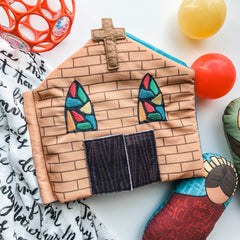
Small Catholic books can give children something appropriate to look at while keeping their attention connected to the faith. A baby may study the bold sacred images in Baby’s 1st Catholic Book, or play quietly with a Mass Quiet Book, while a toddler may enjoy identifying saints in the Peek-a-Boo Saints Board Book.
Preschoolers can practice familiar Catholic words with a Catholic ABC Board Book. Families looking for additional sturdy, child-friendly options can explore the Catholic board book collection.
A child who quietly looks at an image of Jesus, Mary, the Eucharist, or a saint is not being distracted from the faith. That child is encountering the faith at an age-appropriate level.
Bring Fewer Things Than You Think You Need
A bag filled with fifteen objects can create fifteen opportunities for dropping, arguing, searching, or announcing, “I want the other one.” Start with two or three items per child. Rotate them from week to week rather than offering everything at once.
Consider giving items gradually. Begin Mass without the bag. When a child needs help settling, offer one book. Later, you might add a soft rosary or coloring page. This keeps the bag from becoming the main event the moment your family enters the pew.
Think Carefully About Snacks
Families handle snacks differently. Babies may need to nurse or take a bottle, and very young toddlers may genuinely need a small snack depending on the Mass time and their developmental needs.
When snacks are necessary, choose something quiet, simple, and unlikely to leave crumbs across the pew. Avoid loud packaging and foods that become sticky or require several containers. As children grow, gently work toward eating before or after Mass instead.
This is not an invitation to judge another parent’s choices. A parent sitting a few pews away may be managing a medical concern, sensory need, developmental difference, or difficult season you cannot see.
What to Do During Mass with Toddlers and Young Children
Young children participate best when parents give them something positive to do. Constantly repeating “stop,” “don’t,” and “be quiet” can make Mass feel like a long list of corrections. Whenever possible, replace a negative instruction with a simple action.
- Instead of “Stop turning around,” whisper, “Can you find the crucifix?”
- Instead of “Don’t touch that,” say, “Put your hands together with mine.”
- Instead of “Be quiet,” say, “Let’s listen for the name Jesus.”
- Instead of “Sit still,” say, “Stand beside me while we sing.”
Whisper Simple Explanations
A quiet explanation can help a child connect what they see with what the Church is doing. You might whisper:
- “We are listening to God’s Word.”
- “Father is preparing the altar.”
- “Soon the bread and wine will become the Body and Blood of Jesus.”
- “Everyone is kneeling because this is a very holy moment.”
- “We are praying for the whole Church.”
Keep explanations brief. Mass is not the time for a ten-minute theology lesson in the third pew. One clear sentence can be enough to give meaning to what a child is observing.
Invite Children to Join Physical Postures
Children often learn through movement. Help them stand, sit, and kneel with the congregation when they are able. Guide their hands during the Sign of the Cross. Let them place a small contribution in the collection basket. Encourage them to offer the Sign of Peace respectfully.
These actions communicate that the child is a participant, not a spectator.
Give Them One Thing to Watch For
Before Mass, choose one moment for your child to notice:
- The bells during the consecration
- The Gospel book being carried
- The priest washing his hands
- The altar servers lighting candles
- The people bringing forward the gifts
- The congregation saying “Amen”
After Mass, ask whether they noticed it. Over time, these small observations help children learn the structure of the liturgy.
Use Gentle Touch Before Repeated Words
When a child begins to become restless, try placing a hand on their shoulder, inviting them onto your lap, or holding their hand. Physical connection can calm a child more effectively than repeated verbal corrections.
A quiet smile or reassuring hug can communicate, “You are safe, I am here, and we are doing this together.”
Notice Good Moments
Parents naturally notice behavior that needs correction, but children benefit when we quietly affirm what is going well.
Whisper, “You listened so carefully to that reading,” or, “I saw you make the Sign of the Cross.” A gentle smile or squeeze of the hand can reinforce reverence without creating a lengthy conversation.
Try to be specific. “Good job” is kind, but “You knelt so reverently when the bells rang” helps a child understand exactly what faithful participation looked like.
What to Do When Things Go Wrong at Mass
At some point, despite your preparation, a child will cry, shout, drop something, need the bathroom, refuse to kneel, or attempt a dramatic escape down the center aisle. This does not mean Mass is ruined.
Stay as Calm as You Can
Children often borrow our emotional state. When a parent becomes visibly embarrassed or angry, a child may become even more dysregulated. Take one slow breath. Lower your voice. Move deliberately.
You may feel as though every person in the church is watching. Most are not. Many parents and grandparents are remembering their own seasons with young children. Some are silently cheering you on.
Step Out When Necessary
It is appropriate to step out when a child is loudly crying, screaming, or unable to settle. Leaving the pew for a few minutes is not defeat. It is a tool.
Keep the break calm and boring. Walk to the back, vestibule, cry room, or another appropriate area. Offer comfort, help your child regulate, and return when possible.
Try not to make leaving the church feel like a reward filled with running, exciting toys, or unrestricted exploration. The message can remain gentle but clear: “You needed a break. We are calming our bodies, and then we will go back to pray.”
Return to the Pew When You Can
Returning teaches a child that the family still intends to participate. Even if only ten minutes remain, coming back can be worthwhile.
Sometimes returning is not realistic. A baby may be inconsolable, a toddler may be completely exhausted, or a child may have reached their limit. Make the most peaceful decision available without treating the experience as a moral failure.
Handle Bathroom Trips Without Shame
Ask children to use the bathroom before Mass, but remember that small bladders and developing bodies are not always predictable. When a young child says the need is urgent, it may truly be urgent.
Walk out quietly and return without giving the interruption more attention than necessary. As children grow, they can learn to distinguish between a genuine need and a convenient opportunity to explore the hallway.
Do Not Let One Hard Sunday Define Your Family
Perhaps you prepared carefully and everything still fell apart. Maybe you cried in the car afterward. Maybe you wondered whether you should keep trying.
One difficult Mass does not predict the next one. Children change. Seasons pass. Skills grow through repetition. The toddler who once shouted during the homily may eventually become the child who reminds everyone to genuflect.
Age-by-Age Tips for Taking Young Children to Mass
Taking a Baby to Mass
Babies are never being disruptive on purpose. Crying, cooing, squirming, and needing to eat are normal parts of infancy. Choose clothing that makes diaper changes easy. Sit where you feel comfortable nursing, feeding, or stepping out when needed.
A soft carrier may help a baby rest while allowing you to stand and kneel more easily. A quiet high-contrast faith book can also give an alert baby something simple to study.
Do not pressure yourself to follow every posture perfectly while holding or feeding an infant. Care for the child God has entrusted to you. Your loving attention to your baby is not separate from your worship.
Taking a One-Year-Old to Mass
One-year-olds are active explorers. They may want to touch the pew, turn pages, wave at strangers, climb into your lap, climb out of your lap, and repeat the process several times.
Keep expectations modest. Offer one quiet object at a time. Allow appropriate movement within a small space. A child standing quietly beside you may be more successful than a child being forced to sit.
This age may require frequent redirection. Your patient repetition is part of the teaching process.
Taking a Two-Year-Old to Mass
Two-year-olds often have strong preferences and limited impulse control. Give simple choices that both work for you: “Would you like to sit beside me or on my lap?” “Would you like the saint book or the Mass book?”
Avoid asking questions when there is no real choice. Instead of asking, “Do you want to come back into church?” say, “Your body is calm now. We are going back to our pew.”
Practice whispering at home. Make it playful. Tell your child that a church whisper is a tiny voice used for special places.
Taking a Three- or Four-Year-Old to Mass
Preschoolers can begin learning short responses, identifying parts of the church, and listening for familiar words. Teach one response at a time rather than expecting them to memorize everything.
Before Mass, ask them to watch for Jesus on the crucifix, Mary, the tabernacle, the baptismal font, or the Paschal candle. Afterward, invite them to tell you what they noticed.
Simple coloring pages connected to the Sunday Gospel can help at this age, especially during the homily. Keep supplies minimal and quiet.
Taking a Five- to Seven-Year-Old to Mass
Children in this age range are often ready for more intentional participation. Give them a children’s missal or Mass booklet. Encourage them to sing familiar hymns, say responses, and listen for one idea in the homily.
You might ask one question after Mass: “What did you hear about Jesus today?” Do not turn the conversation into a quiz. The goal is to help them pay attention and recognize that God’s Word speaks to their lives.
When Your Child Has Sensory, Developmental, or Medical Needs
Some children experience Mass differently because of sensory processing needs, autism, attention differences, anxiety, developmental delays, trauma, or medical conditions. A strategy that works for another family may not work for yours.
Your child may need headphones, a weighted lap item, a visual schedule, a specific snack, movement breaks, or a consistent seat. These supports are not signs that you have failed to teach reverence. They may be the tools that make participation possible.
Consider speaking with your pastor, religious education director, or another parish leader about your family’s needs. A welcoming parish may be able to help identify a quieter seating area, explain accessibility options, or offer additional support.
Avoid comparing your child with another child of the same age. Development is not a competition. The purpose of going to Mass is communion with God and His Church, not demonstrating that your family can meet someone else’s standard.
How Parents Can Protect Their Own Peace During Mass
Parents of young children often leave Mass feeling spiritually empty because they did not hear every reading, homily point, or prayer. It can be painful to remember a time when prayer felt quiet and focused.
This season invites a different kind of prayer. Your worship may look like holding a tired child while listening to the Eucharistic Prayer. It may look like making a spiritual offering of your frustration. It may look like whispering, “Jesus, help me,” while retrieving a crayon from beneath the pew.
Your attention may be divided, but your presence is still an offering.
Read the Sunday Readings Ahead of Time
Reading the Sunday Gospel before Mass can help you remain connected when caring for children makes it difficult to hear every word. Read it during breakfast, rest time, or Saturday evening. Choose one phrase to carry with you.
Then, even if you spend part of the Liturgy of the Word in the vestibule, you still have a small piece of Scripture to ponder.
Choose One Moment for Focused Prayer
You may not be able to concentrate throughout the entire liturgy. Choose one moment to intentionally refocus, such as the consecration, the Our Father, or the reception of Holy Communion.
Pray one simple sentence: “Jesus, I give You my family,” or, “Help us grow close to You.” A short, sincere prayer can hold great meaning.
Release the Fear of Other People’s Opinions
Courtesy matters. Parents should guide children, address truly disruptive behavior, and teach reverence over time. But fear of judgment can become so loud that it drowns out the reason you came.
You cannot know what every person is thinking. You also cannot build your family’s sacramental life around the possibility that one person may feel annoyed.
Be considerate. Be teachable. Be willing to adjust. Then release what you cannot control.
Build Your Child’s Catholic Faith After Mass
Faith formation does not begin and end within the church walls. The way your family talks about Mass afterward can shape how children understand the experience.
Celebrate One Specific Success
On the way home, name one thing your child did well:
- “You carried the songbook carefully.”
- “I loved hearing you say ‘Amen.’”
- “You came back calmly after our break.”
- “You remembered to bless yourself with holy water.”
Avoid giving a long performance review. Children do not need every mistake discussed immediately after Mass. Focus on progress and address one important concern later if needed.
Create a Gentle Sunday Rhythm
Pair Mass with a simple family tradition: a special breakfast, a walk, a visit with grandparents, pancakes after an early service, or quiet family time at home.
This helps Sunday feel distinct and joyful. Children begin to associate the Lord’s Day with worship, rest, connection, and family.
Practice Mass at Home
Children often process experiences through play. They may line up stuffed animals, carry a book in procession, pretend to ring bells, or use a small table as an altar.
This kind of play can help them remember the order and meaning of what they observed. Guide it respectfully without expecting perfect accuracy. You can explain that they are pretending and that the real Mass is celebrated by a priest.
Bring Prayer into Everyday Life
The more familiar prayer becomes at home, the more natural participation at Mass may feel. Pray before meals. Bless your child before bed. Keep sacred art where children can see it. Read Catholic books together. Practice gratitude and ask forgiveness.
The My First Examen Board Book can help families create a child-friendly rhythm of gratitude and reflection. You can also place encouraging Scripture in your home with Bible verse and Scripture gifts.
These ordinary practices help build the domestic church. Sunday Mass then becomes the center of a faith that is also being lived throughout the week.
Helpful Expectations for Different Seasons
Family life changes quickly. The Mass strategy that worked last month may suddenly stop working. A baby begins crawling. A toddler drops a nap. A preschooler becomes intensely curious. A new sibling arrives. A parent begins attending Mass alone with several children.
Adjusting your approach is not inconsistency. It is attentiveness.
When You Have a Newborn and Older Children
Give older children a clear plan before entering the church. Explain where they will sit, what they may take from the Mass bag, and what should happen if you need to step out with the baby.
Accept help from a trustworthy spouse, relative, godparent, or parish friend when it is available. Catholic family life is not meant to be lived in isolation.
When You Attend Mass Alone with Children
Simplify everything. Choose clothes that are easy to manage, pack fewer items, sit near an exit, and set one priority: keeping everyone safe while attending Mass together.
Do not compare your experience with a family that has two adults, older siblings, or different needs. Showing up alone with young children is a courageous act of faith.
When Your Child Suddenly Resists Mass
Stay curious. Resistance may come from fatigue, fear of a loud sound, discomfort with clothing, a negative interaction, separation anxiety, or a normal desire for control.
Acknowledge the feeling without giving the child responsibility for the family’s decision: “I hear that you do not want to go. It is hard to stop playing. Our family goes to Mass to worship God, and I will help you.”
When You Are Discouraged
Reduce the number of strategies you are trying to use. Pick one small area of focus for the next few weeks. Perhaps your family will work on arriving ten minutes early, learning the Sign of the Cross, or staying in the pew through the Gospel.
Growth becomes easier to recognize when the goal is specific and realistic.
A Simple Sunday Mass Routine for Families
- Prepare: Pack your bag and lay out clothing the night before.
- Connect: Remind children that your family is going to visit Jesus and pray with the Church.
- Arrive: Enter early enough to use the bathroom, choose a seat, and settle quietly.
- Notice: Give each child one sacred object, word, or liturgical moment to watch for.
- Participate: Help children stand, sit, kneel, sing, respond, and pray as they are able.
- Reset: Step out calmly when necessary and return when possible.
- Encourage: Name one specific success after Mass.
- Continue: Bring one idea from Mass into prayer or conversation during the week.
This routine will not produce perfect behavior. It creates a predictable framework that helps children know what to expect. Predictability can bring peace to both children and parents.
A Parent Pep Talk for the Sunday You Want to Give Up
Dear parent standing in the vestibule with a crying baby: you are still at Mass.
Dear parent carrying a toddler who has turned completely rigid: you are still teaching your child that worship matters.
Dear parent who missed the homily because someone needed the bathroom and then needed it again: your presence is still a gift.
Dear parent who feels embarrassed: you are not the first Catholic parent to walk this road. Generations of mothers, fathers, grandparents, godparents, and caregivers have whispered prayers while bouncing babies, guided little hands into the Sign of the Cross, and wondered whether their efforts were making a difference.
They were making a difference, and so are you.
Every Sunday you are building familiarity. You are teaching your child where your family goes for grace. You are showing them that faith is not reserved for moments when life is orderly. We bring our real lives to God: our joy, fatigue, distractions, needs, noise, love, and longing.
Children are not interruptions to the life of the Church. They are members of the Church who are learning how to worship.
You do not need to pretend that bringing children to Mass is easy. Sometimes it is deeply difficult. You may need new strategies, practical help, a different Mass time, a conversation with your pastor, or simply the encouragement to try again next Sunday.
Keep returning. Keep teaching. Keep apologizing when you lose patience. Keep noticing the tiny signs of growth.
One day, the little child you are carrying may walk into Mass beside you. The child you are reminding to whisper may confidently proclaim a reading. The toddler who tries to escape the pew may become an altar server. The preschooler looking through a saint book may grow into an adult who turns to the saints for intercession.
You cannot see the whole story yet. For now, you are planting seeds.
Frequently Asked Questions About Taking Young Children to Mass
Should I bring my toddler to Mass if they cannot sit still?
Yes. Toddlers are still developing the ability to control their bodies and attention. They learn the rhythm of Mass through regular attendance. Set age-appropriate expectations, give them quiet ways to participate, and step out briefly when they become too disruptive to settle in the pew.
Is it okay for a baby to cry during Mass?
Babies communicate through crying. A brief cry or ordinary baby noise is a normal part of parish life. When a baby continues crying loudly and cannot be comforted in the pew, a parent can step into the vestibule or another suitable area, care for the baby, and return when possible.
Where should families with young children sit at Mass?
Choose the place that best supports your family. Sitting near the front helps children see the altar and liturgical actions. Sitting near an aisle or exit makes bathroom trips and calming breaks easier. Many families find that a front-side aisle or side section offers both visibility and flexibility.
What should I put in a Catholic Mass bag for toddlers?
Pack two or three quiet, faith-centered items, such as a Catholic board book, soft rosary, saint cards, reusable religious stickers, or a simple coloring page with triangular crayons. Avoid toys that make noise, roll beneath pews, flash, or contain many loose pieces.
Are snacks appropriate during Mass?
Babies and some very young children may need to eat depending on their age, health, and the timing of Mass. When a snack is necessary, choose something quiet and low-mess. As children mature, families can gradually transition toward eating before or after Mass.
Should I use the cry room?
A cry room can be helpful, especially during a particularly difficult season. However, families do not automatically need to sit there simply because they have children. Choose the location where your children are most able to see, learn, and participate while allowing you to respond to their needs.
What should I do when my child has a tantrum during Mass?
Stay as calm as possible and move to a quieter area. Help the child regulate without turning the break into playtime. Use simple language, such as, “You are upset. I am here. We will calm down and go back.” Return to the church when the child is ready and it is reasonable to do so.
How can I teach a preschooler to participate in Mass?
Teach one small skill at a time. Help your child make the Sign of the Cross, say “Amen,” join a familiar response, find sacred objects, or listen for the name of Jesus. Briefly explain parts of the liturgy and celebrate specific examples of participation afterward.
What if people seem annoyed by my children?
Be considerate and address behavior that is truly disruptive, but do not assume every glance is criticism. Most parishioners understand that children are learning. Focus on calmly guiding your child and remember that your family belongs in the worshipping community.
What if I attend Mass alone with several young children?
Simplify your expectations and preparation. Sit near an exit, bring only essential items, establish clear rules beforehand, and accept appropriate help from trusted parishioners. Success may simply mean keeping everyone safe and remaining at Mass for as long as reasonably possible.
How do I get anything spiritually meaningful from Mass while managing children?
Read the Sunday readings beforehand, choose one part of the liturgy for focused prayer, and offer your acts of care to God. You may not experience long periods of concentration during this season, but your loving service, perseverance, and presence can become part of your prayer.
Keep Showing Up with Your Beautiful, Real Family
Taking young children to Mass requires preparation, flexibility, humility, humor, and a great deal of grace. Some weeks you will see progress. Other weeks you may feel as though you are beginning again.
Keep going.
Pack the little books. Practice the whisper. Sit in a new pew when the old spot is not working. Step out when you need to. Return when you can. Receive the Eucharist. Begin again next Sunday.
Your family does not need to become perfectly quiet before approaching God. Bring Him the family you have today. Bring the wiggles, the questions, the tired eyes, the tiny shoes, and the sincere desire to raise children who know they are loved by Jesus.
The work may feel hidden now, but you are creating memories, habits, and a spiritual home. You are showing your children that in every season of life, the Church is where your family comes to meet Christ.
We’re honored to be your trusted online Catholic store for faith-filled inspiration and meaningful gifts. Whether you’re shopping for a Catholic gift for a loved one, exploring new Christian books, or looking to deepen your prayer life with our curated collection of Catholic books, we’re here to help you grow closer to Christ.
Our mission is to make beautiful and reverent Christian gifts accessible to Catholic women, families, and gift-givers everywhere. From prayer tools and devotional art to kid-friendly saint dolls and Marian apparel, every product is designed with your spiritual journey in mind.
Discover why Catholic moms and gift buyers trust us for thoughtfully made, faith-centered items. We ship quickly from our shop, and you can explore our full collection 24/7 at TheLittleRoseShop.com – your go-to online Christian store for authentic and uplifting Catholic products. Stay connected for the latest product launches, exclusive offers, and heartwarming faith content.Thank you for supporting a small, faithful business. Your purchase supports more than just a shop – it supports a mission to bring beauty, truth, and goodness into every Catholic home.